
The book of Proverbs has 16 Proverbs about alcohol consumption. The alcohol proverbs are meant to teach something and are written authoritatively. Some of the Alcohol Proverbs could stand alone, but are better understood as a collection and balanced against one another and the rest of scripture. A few need some translation, but most are straightforward in their meaning. One proverb includes sailing terminology, so it needs some explanation related to sailboats.
Before we look at the verses, it is important to understand that the Proverbs are not meant to be treated like commandments. When Jesus said in John 14:15, “If ye love me, keep my commandments”, he did not say “If ye love me, keep my Proverbs.” Although the Proverbs are considered scripture and breathed by God, the Proverbs are not meant to be like commandments. Instead, the Proverbs are a collection of sayings that if followed will result in your life working out better most of the time than if you do not follow them. If you follow the Proverbs, you are considered wise and if you do not you experience folly.
Stephen Voorwinde’s Wisdom for Today’s Issues, P & R Publishing, 1996 lists all Proverb verses by subject to make it easier to study the book of Proverbs. Proverb verses 20:1; 21:17; 23:19-21; 23:29-35 and 31:4-7 are listed as the Proverbs that focus on alcohol. All are quoted below from the Holy Bible, KJV with my interpretation of their possible meaning for Christian sailors.
Verses and Meaning:
20:1 “Wine is a mocker, strong drink is raging: and whosoever is deceived is not wise.”
The author personifies wine as if wine were a difficult person who deceives anyone who drinks it by going into a rage and mocking the person who drinks it.
21:17 “He that loveth pleasure shall be a poor man: he that loveth wine and oil shall not be rich.”
Wine and oil were expensive commodities in the ancient world. The Magi brought three valuable gifts to the baby Jesus, including the oil Myrrh. Another proof of this is in Psalm 104:15 which says, “And wine that maketh glad the heart of man, and oil to make his face to shine, and bread which strengtheneth man’s heart.” Wine and oil along with bread were the essential provisions for life in ancient times.
Numerous references in the Bible illustrate the importance of wine. Examples include wine for use as medicine (Timothy 5:23), a beverage at weddings (John 2:1-11) and religious observances (Exodus 29:40).
In summary, Proverbs 21:17 describes how you should not consume too much wine or oil. They were both expensive, and consuming too much would make you poor in terms of money. On a spiritual level, you would also be poor if you think too much about consuming these precious commodities, especially the wine.
23:19-21 19 “Hear thou, my son, and be wise, and guide thine heart in the way.”
20 “Be not among winebibbers; among riotous eaters of flesh:” Verse 20 describes how one should not be a winebibber (a person who drinks large amounts of wins on a habitual basis) or a riotous eaters of flesh.
21 “For the drunkard and the glutton shall come to poverty: and drowsiness shall clothe a man with rags.” Verse 21 describes a person who is a drunkard and how that person will experience drowsiness and shall wear rags and how gluttons shall come to poverty.
In summary, Verse 23:19-21 means that if you want to be wise you will not drink wine and eat meat excessively.
23:29-35 29 “Who hath woe? who hath sorrow? who hath contentions? who hath babbling? who hath wounds without cause? who hath redness of eyes?” Verse 29 is straightforward if you just examine the words individually. Woe means grief, regret, or distress and sorrow means deep distress or sadness or regret. Contentions means anger or disagreement, babbling means foolish talk or slurring your speech. All of these, plus experiencing mysterious wounds without a cause and redness of eyes, are symptoms of excess drinking. A drunk might run into a wall and hardly notice until the next day. Waking up with bloodshot eyes is a common occurrence for those who drink too much.
30 “They that tarry long at the wine; they that go to seek mixed wine.”
Verse 30 describes a person who drinks wine over a long period of time, and who seeks out mixed wines that might be stronger or more potent, or taste better by adding spices. In other words, don’t make the consumption of wine a big focus in your life so you drink more.
31 “Look not thou upon the wine when it is red, when it giveth his colour in the cup, when it moveth itself aright.”
Verse 31 means that you should not stare at your wine as you drink it for hours to contemplate its color or how it swirls in a glass. Basically, this means don’t make wine so important that all you do is think about wine resulting in making wine too important in your life.
32 “At the last it biteth like a serpent, and stingeth like an adder.”
Verse 32 seems straightforward if you understand what serpent and adder mean. Based on Merriam-Webster, it basically says if you drink wine the result may be as bad as being bitten by a serpent (a noxious creature that creeps, hisses, or stings) or being stung like an adder (snake).
33 “Thine eyes shall behold strange women, and thine heart shall utter perverse things.”
This also seems straightforward. If you are under the effect of alcohol, you may be tempted to seek after women other than your wife leading to adultery or fornication. You may also say perverse things and turn away from what is right or good.
34 “Yea, thou shalt be as he that lieth down in the midst of the sea, or as he that lieth upon the top of a mast.”
All sailors know that lying down in the middle of the sea would be a very foolish and dangerous thing to do. You could be attacked by a shark or be lost at sea and drown. It would be very uncomfortable to lie down on the top of a pointy mast. If you fell, you could also be hurt or possible die.
35 “They have stricken me, shall thou say, and I was not sick; they have beaten me, and I felt it not: when shall I awake? I will seek it yet again.”
Verse 35 describes a hangover from drinking too much. So, if you drink too much, you will feel like you have a disease even though you are not sick. You will also feel like you have been beaten, but you do not remember the beating or feel it. Finally, it ends with the prediction that you will seek it again when you wake up.
31:4-7 “It is not for kings, O Lemuel, it is not for kings to drink wine; nor for princes strong drink.”
“Lest they drink, and forget the law, and pervert the judgement of any of the afflicted.”
“Give strong drink unto him that is ready to perish, and wine unto those that be of heavy hearts.”
“Let him drink, and forget his poverty, and remember his misery no more.”
I am combining the analysis of these four verses since they are straightforward. These four verses mean that kings and princes should not drink wine or strong drink, so they do not forget the law, and turn away from what is good and become corrupt.
It is also interesting that after all the previous verses indicating that drinking wine excessively is unwise, these new verses clearly say that wine can be drunk by those who are dying or who are heartbroken. So drinking wine is OK in at least those circumstances and maybe others we will look at later.
Today there are not many kings, so the meaning of this in the modern day is that leaders should not drink wine or strong drink. I think this could apply to anyone who has any significant responsibility for leadership including a captain of a sailboat.
Grouping of Proverbs on Alcohol:
Proverbs that describe the possible consequences of drinking alcohol. Proverbs 23:32-35
Proverbs that describe what to do instead of drinking alcohol: Proverbs 23:19-20
Proverbs that describe what you will feel like and the consequences of drinking alcohol: Proverbs 20:1, 21:17, 23:21, 23:29, 23:32-35.
Proverbs describing how badly it feels when you drink: Proverbs 23:30-31
Proverbs dealing with kings and princes drinking alcohol. Proverbs 31:4-7.
Proverbs describing when it is OK to drink alcohol: Proverbs 6-7.
Five Key Universal Principles in the alcohol proverbs:
-
- Don’t drink wine or other alcoholic drinks to excess.
- Don’t waste commodities like oil and wine and don’t waste time with a drink in your hand for hours.
- If you drink at all, don’t drink for long periods of time.
- Realize that strong drink could lead to your ruin.
- It is OK for those dying or heartbroken to drink wine.
So, what does this all mean?
My observation of people who drink is that there is a gradient of how alcohol affects people. The consequences of drinking alcohol are felt quickly and severely by some but have far less effect on others. Some people seem to climb into a bottle with terrible consequences on their careers, marriages, friendships, and physical well-being. Others seem less affected, but in all cases, you can see how excessive alcohol diminishes what they could have been.
Next, we will examine teachings from elsewhere in the Bible that are crucial to understanding the Alcohol Proverbs. The alcohol proverbs teach us that overconsumption of alcohol is unwise. The alcohol proverbs and other parts of the Bible also indicate that alcohol can be drunk to relieve the dying or brokenhearted, at celebrations or religious ceremonies, or other reasons. Other examples from scripture in other parts of the Bible include the following:
John 2:1-11 describes the marriage in Cana where Jesus performed his first miracle and turned a large volume of water into wine. Based solely on this fact, Jesus could be thought to approve of wine at least for weddings. When his Mother Mary said to Jesus that they have no wine, if Jesus did not approve of wine, Jesus could have said to drink the water instead, but he didn’t.
Jesus also said in Luke 22:20, “This cup is the New Testament in my blood, which is shed for you.” Obviously, this shows that wine was not only approved by Jesus, but in 1 Corinthians 11:24, he commanded his believers to drink it. “….this do ye, as oft as ye drink it, in remembrance of me.”
Based on these two verses, it appears that it is OK to drink in moderation at least at weddings and religious ceremonies. The problem with alcohol appears to mainly be if it is habitual and if you drink too much.
After a hot day on the water sailing, in my opinion, it is very enjoyable to have a cold beer. The alcohol proverbs make me realize that I must be very careful with this, or I could become a beerbibber instead of a winebibber. Although the Alcohol proverbs only mention wine, I am sure the alcohol proverbs apply to any alcoholic beverage including beer, whisky, gin, vodka, etc.
Conclusion: If your pockets are empty because you drink expensive alcoholic beverages, or you become drowsy and sometimes pass out when drinking, or drinking makes you hungry and you eat out of control and are fat, or if you slur your speech when drinking, or if you sometimes run into a wall or boat on the hard at a marina after drinking, or if you have gotten a black eye you can’t remember, or if you have walked off a marine dock into the water after drinking, or if you look crazy with blood shot eyes after drinking, or if you sometimes worry that drinking has destroyed your life like a snake biting you, maybe you should seek the wisdom in Proverbs and stop the folly of drinking excessively.
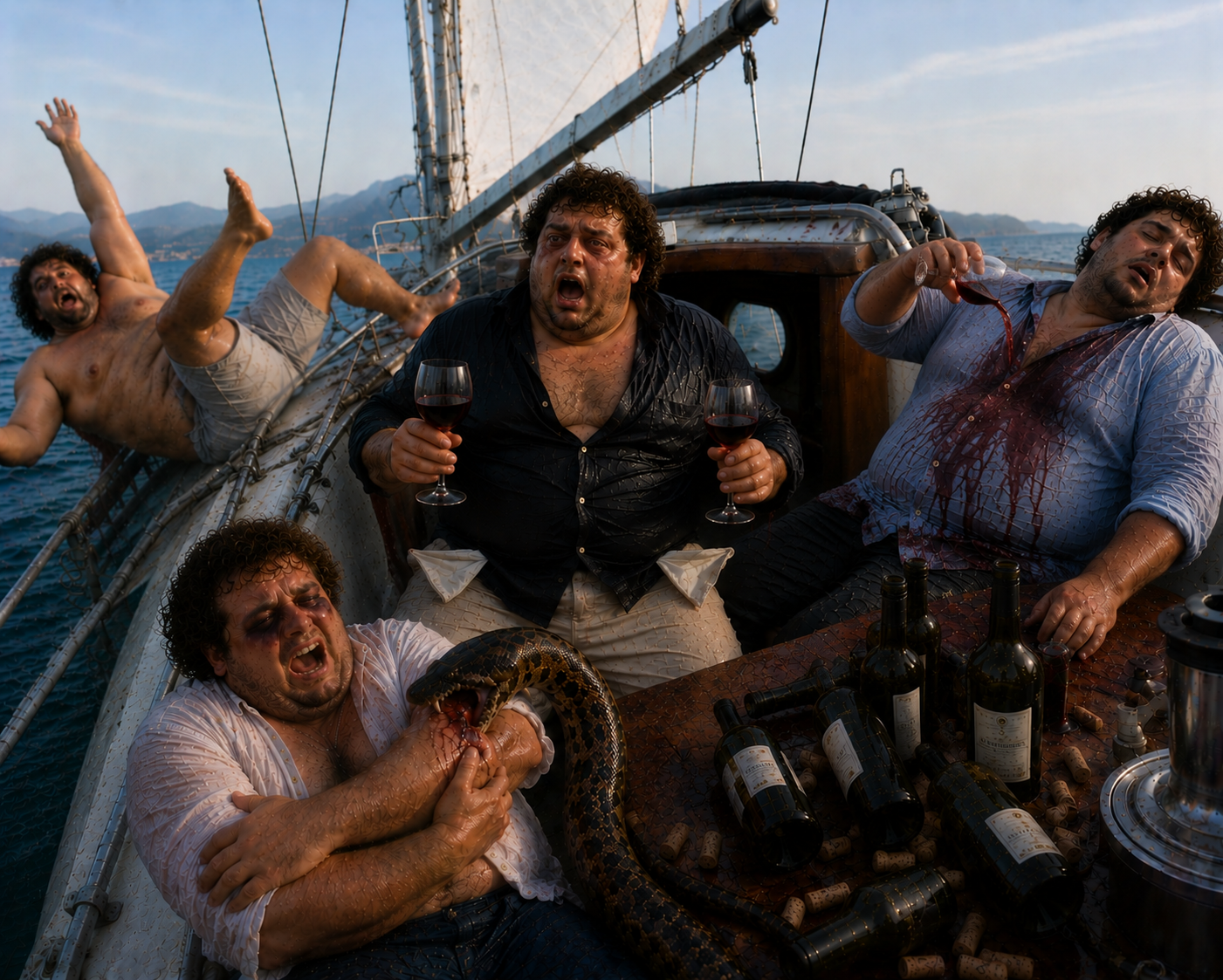
How many bad consequences from excessive drinking described in Proverbs can you identify in the picture?
Although Proverbs does not say much about the consequences of excessive drinking beyond our earthly life, Paul, in Ephesians 5:17-18, uses words that seem to be right out of the book of Proverbs, "Wherefore be ye not unwise, but understand what the will of the Lord is. And be not drunk with wine...." Paul, in 1 Corinthians 6:9-10, explicitly states that drunkards, among other sinners, will not inherit the kingdom of God.
Works Cited:
Voorwinde, Stephen, Wisdom for Today’s Issues, P & R Publishing, 1996.
Holy Bible: The Old and New Testaments King James Version. Holman Bible Publishers, 2023.